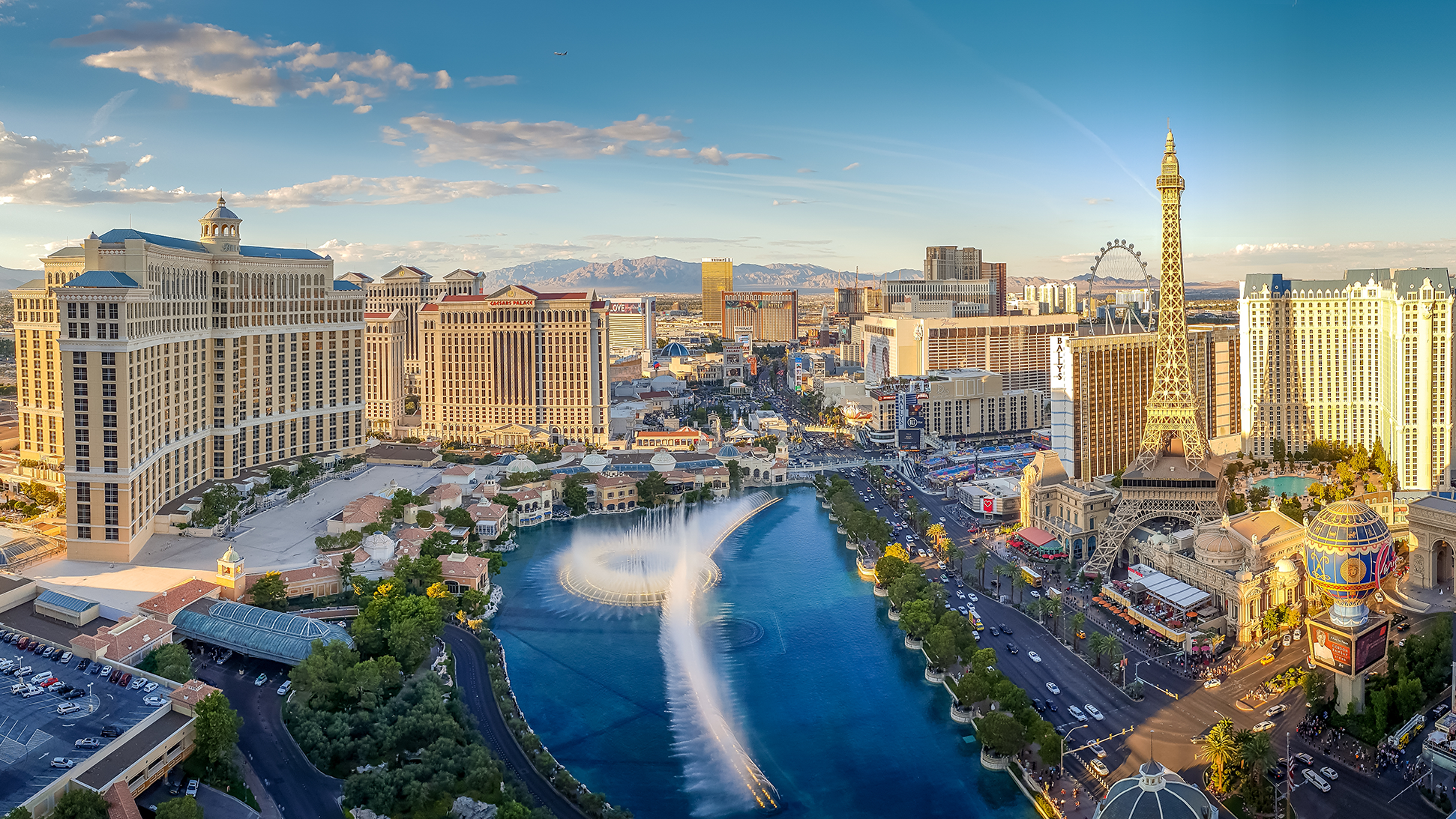

An $18 billion takeover bid for MGM Resorts has put Las Vegas back in the spotlight — and beyond the famous 4-mile Strip, a consumer-driven economy is showing early signs of recovery across every major asset class.
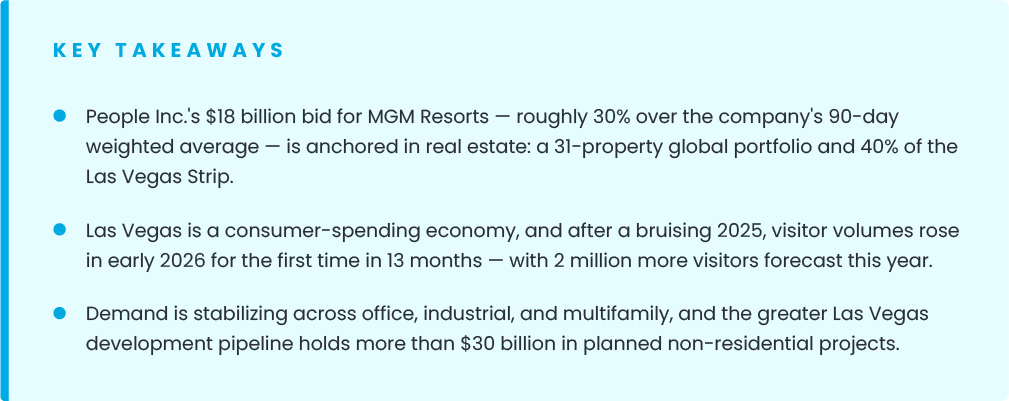
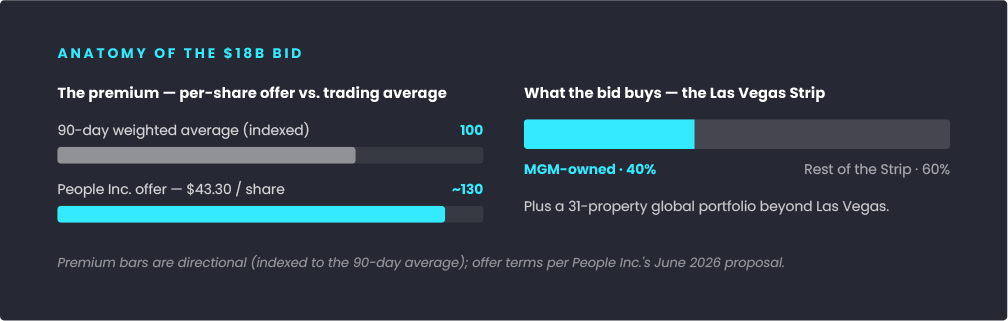
In June, People Inc. submitted a headline-grabbing proposal to purchase MGM Resorts International for $18 billion. The price tag alone caught attention. Representing $43.30 per share, the price comes in at roughly 30% over MGM’s 90-day weighted average at the time of the proposal, making it an aggressive offer from the media conglomerate to take over operations.

At the center of that value, is the company’s real estate portfolio. MGM has a 31-property global portfolio and owns 40% of the Las Vegas Strip. In an interview shortly before submitting the proposal, People Inc.’s Executive Chairman and Senior Executive Barry Diller said MGM is “a rare kind of business: one with real world assets that AI cannot easily replicate or disintermediate and exceptional digital growth opportunities. That conviction has only strengthened over time.”
However, the story in Las Vegas is a complex one. Outside of the famous 4-mile Las Vegas Strip is a diverse real estate landscape that has experienced spurts of meaningful growth and development alongside economic challenges and wavering demand. But when Diller sees an opportunity, it’s worth a second look.
An Economic Barometer
As it happens, Las Vegas is often a trustworthy gauge—or even a foretelling crystal ball—for the economic health of the nation. The city is driven almost entirely by consumer spending, and so is the nation. When consumer spending dries up in Las Vegas, it may be an indicator of an incoming national downturn. Reporting in March from The New York Times expressed such a concern. While the VIP section of the strip thrives, overall tourism volume is down. “Sin City’s financial well-being has long relied on millions of tourists spending their discretionary income indiscreetly,” writes The New York Times. “But in an economy where the affluent thrive while the rest struggle, that formula is in trouble.”
The trouble is showing up in the profits of local businesses, which are struggling to stay open. Some owners report difficulties covering expenses and profit losses of as much as 70%. That loss is translating to job and income loss for local workers and is exacerbating affordability challenges in the city.
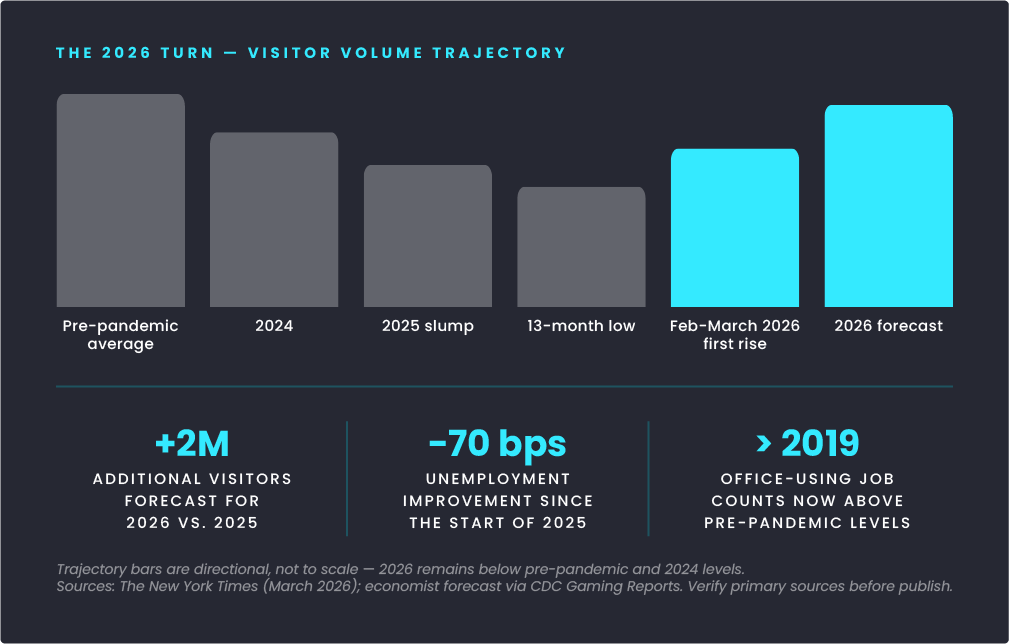
Much of the concern stems from a tourism slump in 2025, but this year, things are starting to look up. In February and March, visitor volumes increased for the first time in 13 months, and overall, economists estimate 2 million more visitors will come to the city in 2026 than in 2025. That’s all a push in the right direction, and a sign of the city’s resiliency. While those numbers still trend below pre-pandemic averages, and even tourism in 2024, it’s also a sign of recovery. The unemployment rate has also started to improve, trending down 70 basis points from the start of 2025, and office-using job counts are higher than before the pandemic.
Demand Heads in the Right Direction
Unsurprisingly, the economic performance has also impacted local real estate demand across asset classes. The major verticals all saw some disruption last year. But, like the local economy, 2026 has shown signs of improvement. The office vacancy rate inched down 30 basis points to 12.4%, absorption increased, sublet vacancy is low, and Class-A properties are actively leasing. Overall, small leases of less than 10,000 square feet are driving leasing activity; suburban hubs, like Henderson, Summerlin, and Southwest Las Vegas, are seeing strong office demand.
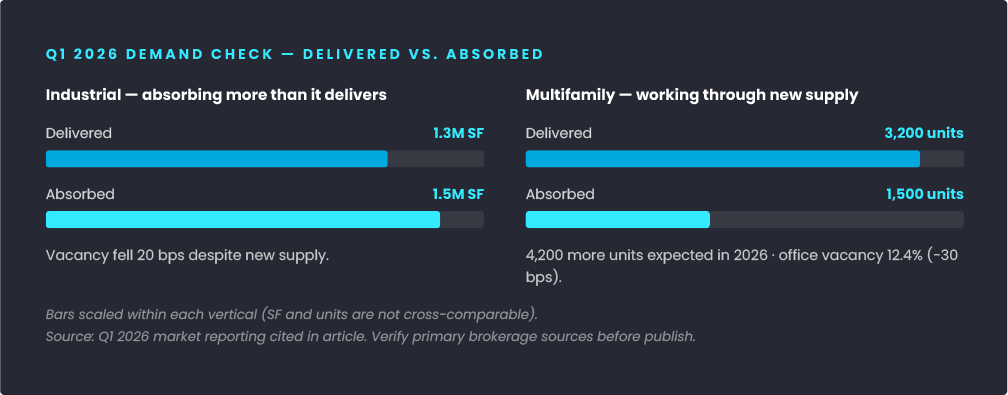
The industrial market is a story of stability. Industrial has continued to see strong new construction activity, and in the first quarter, 1.3 million square feet delivered to the market with 1.5 million square feet of absorption. As a result, the industrial vacancy fell by 20 basis points despite the strong new deliveries. The market also saw some significant deals. Pepsi Co. leased 1 million square feet in the North Las Vegas Logistics Center, and PCCP purchased an Amazon-occupied center for $124 million. Still, the developers are beginning to slow down on new speculative development as the market responds to new deliveries. But the long-term outlook is healthy. Las Vegas’ population growth and infrastructure enhancements support long-term growth in the sector.
In multifamily, job growth and reduced unemployment are supporting apartment renter demand. Net absorption has remained positive, although it lags behind significant new construction deliveries. In the first quarter, 3200 units were delivered to market, while 1500 units were absorbed. As a result, the vacancy rate has increased somewhat and asking rents are lower than they were a year ago. With 4200 units expected to deliver this year, there remain some supply-side obstacles, but the market is expected to remain stable even as new supply comes to market, and popular submarkets will remain active.

While the market has clearly experienced challenges in the last year, demand in the core verticals is showing resilience, despite some broader economic hurdles. As Las Vegas Mayor Shelley Berkley told The New York Times, the city has seen worse economic downturns, including the 2008 Financial Crisis. “Las Vegas is very resilient, and we always bounce back,” she says. “I think this city is very accustomed to making lemonade out of lemons.”
Development Optimism Endures
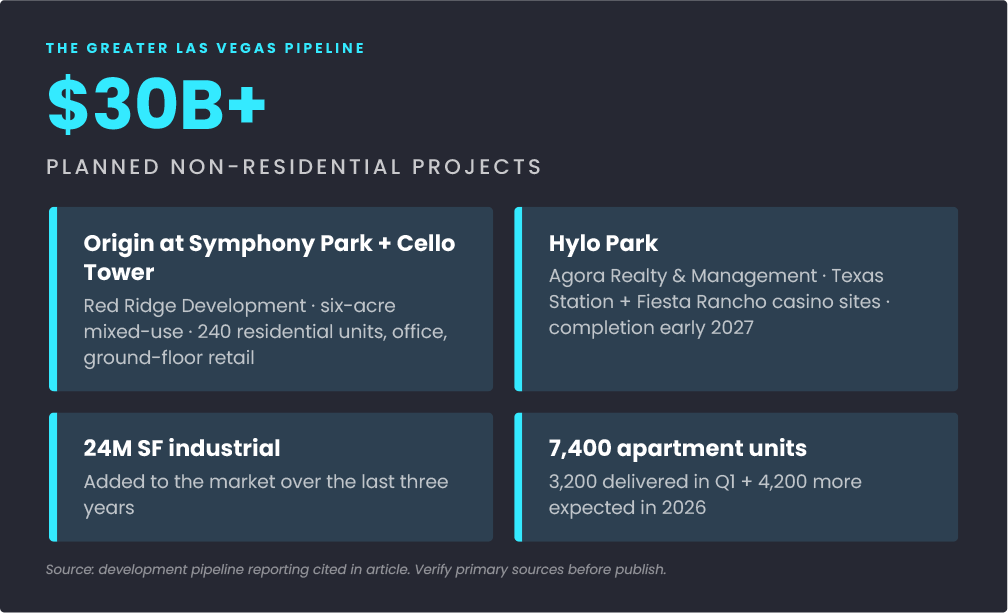
For developers, these economic patterns and demand trends are the key to deciding if the city—or a particular project—is worth the risk. Currently, the city has an active development pipeline. In addition to the 3200 apartment units to deliver in the first quarter, the city is set to see another 4200 come to market, and the industrial market has added 24 million square feet in the last three years.
However, large-scale, mega projects and infrastructure projects are driving new construction activity in the greater Las Vegas area, and they illustrate the continued evolution of the Greater Las Vegas market. There are more than $30 billion in planned non-residential projects in the development pipeline, including Red Ridge Development’s Origin at Symphony Park and Cello Tower, a six-acre mixed-use project with 240 residential units, office and ground floor retail; and Agora Realty and Management’s Hylo Park project, a revitalization of the Texas Station and Fiesta Rancho Casino sites with residential, office, retail and a sports center, all slated for completion in early 2027.
With a closer look at the market, it’s no wonder why Diller is so enthusiastic about the MGM portfolio. Las Vegas is a vibrant, evolving market. While it is seeing some setbacks, largely influenced by the macroeconomic and geopolitical environment, the city has several bright spots and continues to see growth.