
People are on the move again – this time past the suburbs entirely. The fastest-growing cities in America are now the exurbs, and development opportunities are flowing.
Commercial real estate developers follow the people—and people are almost always on the move. During the pandemic, people fled major metros and expensive cities for smaller, affordable metros and suburban markets with space and sprawl. From the start of the pandemic in 2020 to the end of 2021, more than 56 million people migrated to new cities, mostly in the Sunbelt. Today, people are on the move again. This time, they are heading to the exurbs.
The exurbs are areas that sit outside of major metros and beyond the typical suburbs, combining the benefits of a short drive into the city for work or entertainment with small town or rural charm. The Wall Street Journal recently declared the exurbs the “future of American cities,” thanks to massive migration to these areas. Many of these exurbs have lower housing costs, more space and have attracted master-planned community development to support the inward migration. Here is a closer look at the increase in migration to exurban communities and how commercial real estate developers can take advantage of the emerging population growth.
The Appeal of Urban-Adjacent Cities
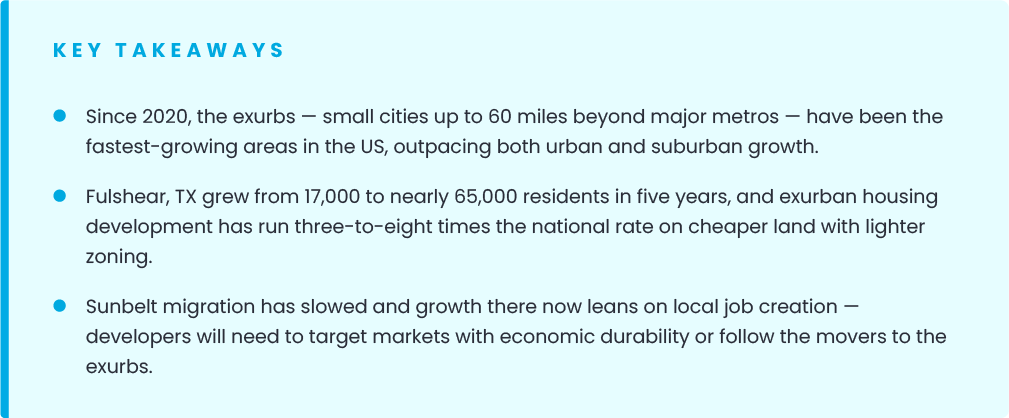
Exurban locations are growing rapidly. Since 2020, the exurbs have been the fastest growing areas in the US, outpacing both urban and suburban growth. Across the country, small metropolitans that sat outside of major metros—by as much as 60 miles—had the largest increase in population growth and outpaced population gains in big cities. These markets almost universally have the same benefits: good schools with fewer students, tighter communities, larger homes and lot sizes and less traffic. It’s a slower pace of life, and Americans are embracing it.

The migration to these markets has exploded in just the last few years, creating a new trend in migration that is reshaping American cities. People moving to the exurbs are value “space, affordability and flexibility over proximity,” according to Axios. The growth has widespread impacts, from changing congressional apportionment to shifts in federal funding, but beyond the political, population growth will also lure additional investment and change the shape of communities and real estate development.
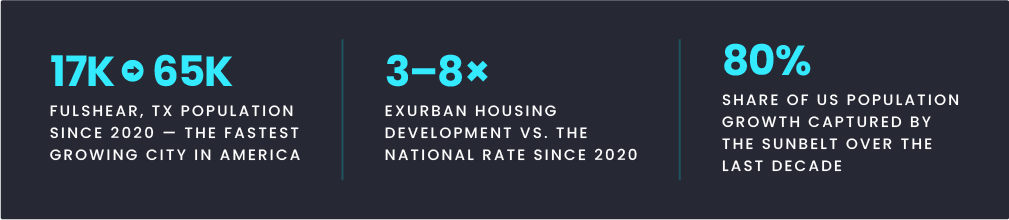
The latter is a big part of the equation. Since 2020, housing development in exurban cities has surpassed the national rate by three-to-eight times. While developers are following migration patterns, the exurbs also offer more opportunities for developers to build. Land is cheaper, for one. Competition is also lower and there is generally more planning and zoning flexibility. Developers can build housing and commercial infrastructure with bigger margins and benefit from growing demand.
Exurb Growth Across the US
In most cases, the exurbs cities are not names that one would immediately recognize. Markets like Fulshear and Celina in Texas; Goodyear, Buckeye, Surprise and Avondale in Arizona; and Cary, Chapel Hill, Apex and Holly Springs in North Carolina. These small cities are adjacent to major metros, and each has seen an explosion of population growth in the last five years.
Fulshear, Texas, tops the list. In 2020, the city had a population of 17,000. By mid-2025, the city had grown to nearly 65,000 people, making it the fastest growing city in the country, according to reporting from The Wall Street Journal. Fulshear is located just 35 miles from Houston. Celina, Texas, is a similar story. Located outside of Dallas, the city has added 13,000 people a year since 2020, growing to just over 64,000 people. Not even large Texas metros like Houston have added people at the same pace.
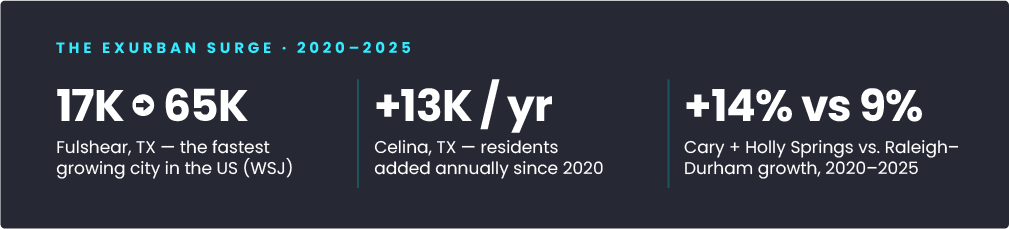
The growth is happening all over the country. In North Carolina, the life science boom in Raleigh and Durham has catalyzed growth. Right of the surrounding exurbs, cities like Cary and Holly Springs, have collectively grown by 14%, reaching a size of more than 500,000 people between 2020 and 2025. By comparison, Raleigh and Durham have grown 9% in the same timeframe.
This is not an unusual trend. Growth in urban markets has slowed significantly or even contracted, but even where urban markets are growing, Axios notes that exurbs are substantially outpacing growth. This is especially true in standout growth cities like Dallas, Phoenix, Atlanta and Raleigh, where outer ring metros are seeing outsized growth.
Sunbelt Continues to See Outsized Growth
For decades now, the Sunbelt has been the spotlight region for inward migration. Over the last decade, this region has accounted for 80% of the total population growth. During the pandemic, cities in the Sunbelt captured the vast majority of moving Americans, producing massive spikes in demand, housing costs, rent growth and ultimately, new construction. The exurbs are now outpacing that growth trend and stealing a portion of the spotlight—but not all of it.
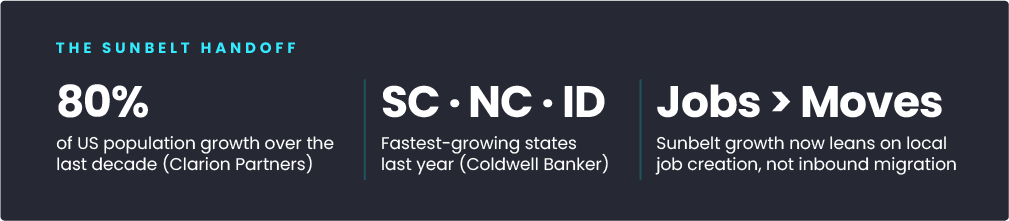
The Sunbelt continues to attract population growth in select metros. Texas and Florida are still the most popular destinations, and even the exurbs in these states are benefitting from the growth and interest, but even domestic migration to these markets has slowed significantly in recent years. As a result, growth in the Sunbelt is now more reliant on economic factors, like local job growth, than external migration to fuel demand growth. Now South Carolina and North Carolina have stepped in the spotlight as the fastest growing states last year, along with an outlier: Idaho. According to Coldwell Banker, these trends suggest “the demographic surge that reshaped CRE investment strategies during the early 2020s is transitioning into a more complex phase—one with several implications for property markets.”
This trend will likely require a shift in commercial development strategy as communities evolve and priorities shift. Developers will likely need to target markets with economic durability or shift again to the exurbs where people are moving.