


From targeted valuations to exit forecasting, AI-driven analytics is replacing gut instinct with sharper, faster, and more defensible risk analysis across the development lifecycle.
The commercial real estate industry has widely and fervently embraced AI. Externally, some experts estimate that the arrival of AI will generate 330 million square feet of new demand over the next decade, while reshaping property fundamentals, but the internal adoption of AI is also transforming traditional investment practices. Companies are automating workflows and routine tasks, increasing efficiency and productivity and leaning on data to make more informed decisions that ultimately improve investment outcomes. The technology has a myriad of applications across asset classes and investment
For commercial real estate developers—who are arguably the biggest risk takers in the industry—data-backed and AI-driven risk analysis is among the biggest benefits of the technology boom. From the initial valuation to securing financing to stabilization and all the way through the exit, developers perform deep risk analysis on every project. While data has always played a key role in turning a gamble into an educated bet, today, AI and predictive analytics tools are producing sharper, faster and more accurate insights based on much more recent and robust data. The result is transforming risk analysis and giving developers a clear picture of the market.
Here are three ways that data is improving risk analysis in the commercial real estate development lifecycle.
Targeted Valuations
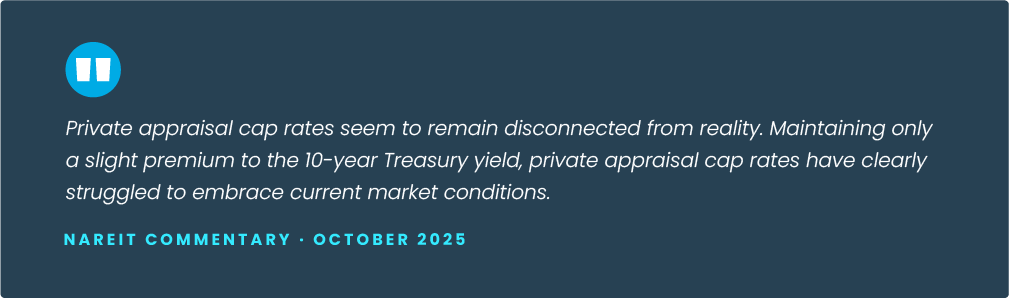
For the last five years, there has been a deep divide between buyers and sellers on pricing. With healthy income at many properties, sellers have sought to maintain pricing, while elevated interest rates have warranted a discount on the buyer side. As a result, there has been a disconnect on cap rate discovery between buyers and sellers. A commentary published by NAREIT in October 2025 said, “Private appraisal cap rates seem to remain disconnected from reality. Maintaining only a slight premium to the 10-year Treasury yield, private appraisal cap rates have clearly struggled to embrace current market conditions.” As a result, an unusual divergence between public and private valuations emerged, contributing to slower transaction volumes.
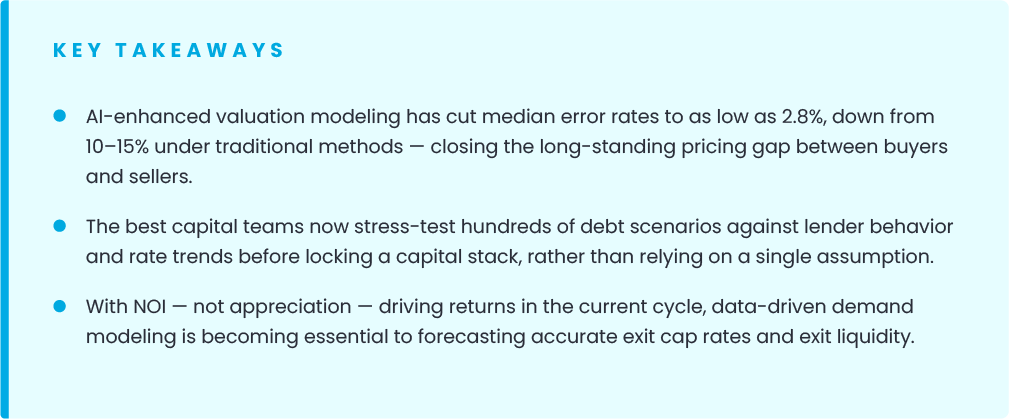
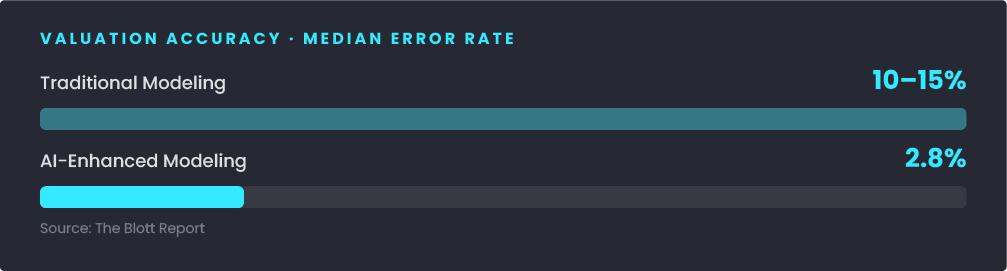
Data-backed valuation analysis is helping to close that divide by tracking robust transaction data, including bid activity, broker revisions to marketed deals and deal fallout alongside more common transaction data, like closings and final pricing. The depth of this transaction data, which can be mined and analyzed through AI-driven software, gives both buyers and owners real-time insight into highly localized market indicators, like pricing trends, transaction velocity and current demand. Property stakeholders can then set more accurate cap rates that reflect current market trends. According to The Blott Report, AI-enhanced modeling has improved the median error rate to as low as 2.8%, down from an average of 10% to 15%. That’s a major advantage to both buyers—who gain downside protection risk—and sellers—who can preserve as much equity as possible despite macro market setbacks.
Stress Test Debt
In the current market cycle, the best capital teams are running multiple scenarios for every deal in an attempt to find the best debt or capital package. A multi-scenario strategy is essential to hedge against fluctuating interest rates. This year, CRE funding remains “selective,” and “conviction is uneven,” according to Northmarq. In fact, capital is available—Northmarq calls it a “well-funded market”—but, “timing, structure and borrower confidence” are the characteristics that are most important to secure attractive debt today.
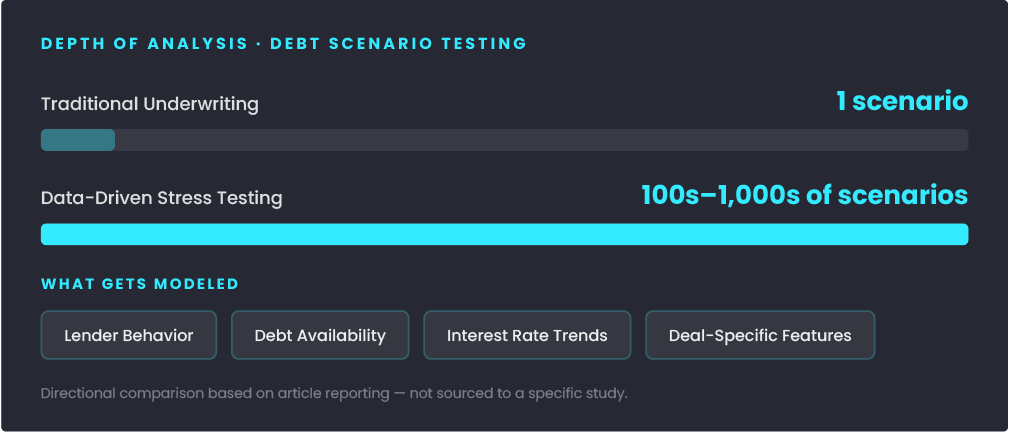
With a data-driven strategy, investors and developers can run hundreds or thousands of scenarios to truly stress test debt sourcing and build a more effective capital stack. Data modeling can include lender behavior, debt availability and interest rate trends. Data and analytics software can analyze these metrics across lender types, too, and make recommendations on the best debt scenarios for a particular strategy or deal-specific features.
A recent commentary in The Financial Brand explains the benefits of AI stress testing perfectly: “AI’s influence operates invisibly in the background, surfacing patterns and outliers that might take humans days or weeks to notice. AI illuminates these overlooked opportunities through speed, structured data and pattern recognition. Risk appetite isn’t looser. It’s better informed.” This is the benefit of employing a data-backed strategy. You don’t change the equation, you enhance it to uncover the best debt opportunities that can drive better returns.
Forecasting Exit Liquidity
Exit liquidity is an important metric in the analysis of a perspective development project. Developers need to forecast the valuation at completion and determine an accurate exit cap rate. However, in the current environment where NOI (not asset appreciation) is driving returns, developers can find it difficult to forecast an accurate exit cap rate. On the investment side, exit liquidity has become harder to achieve.

CBRE’s Spencer Levy calls exit liquidity an “illusion” in the current market. “I say illusion, not that it doesn’t exist. It does exist. But in a world with high interest rates, it’s going to exist less as a percentage of your overall return.” But, for developers, it is a requirement. Predicting the right exit liquidity can make or break a deal. To get it right, developers need to understand everything from investor demand and appetite to valuation trends. Using a data and analytics software to forecast the market trends and deeply analyze investment appetite helps deliver an accurate exit cap rate and predict exit liquidity of a project. A thorough analysis can help a developer time the market and build an asset with a deeper well of investment demand.

Northspyre’s proforma tools is a great example of the way that AI-driven data and analytics can bolster projections. It models multiple scenarios and analyzes market trends to deliver accurate forecast at the first look at a project.
Accurate projections and scenario modeling is an important part of prospective deal risk analysis, but with AI-driven tools, developers are able to run more scenarios, understand upside and downside risk and thoroughly vet more prospective deals. In the current environment where volatility is a constant and margins are narrow, the ability to analyze more scenarios across more prospective projects is a competitive advantage.