
Amenity wars in commercial real estate are nothing new. Developers are routinely competing to deliver more and more spectacular amenities into buildings—and the list is always evolving. The amenity lists range from the common, like resort-style swimming pools, luxury clubhouses and sprawling gyms and fitness centers, to the unique, like dog grooming facilities, bike repair shops, cryotherapy chambers and wine storage cellars.
There is no limit to the creativity of these amenities—but they always follow demand trends. Dog grooming aligned with an increase in tenants with pets, and bike repair emerged as more prospective tenants owned bicycles. So, it will probably not be surprising to hear that the AI boom is now having a similar impact on the amenity race among developers.
Today, developers are leaning into the ubiquity of AI by installing tech-enhanced amenities in apartment, condo and office properties. Many developers are already seeing tremendous benefits integrating technology into project management. Software programs like Northspyre are using AI, machine learning and predictive analytics to manage and automate processes and create valuable efficiencies.
But, tenant-facing tech-backed amenities are driving just as much value on the operational side.
Residents and tenants use technology seamlessly in their daily and professional lives, and expect high-quality buildings to have the same functional technologies integrated into the experience. And, just like earlier amenity wars, these tech-centered features range from the practical to the unique. Here is a sampling of some of the common tech-enhanced amenities popping up in new commercial real estate properties.
Tenant Experience Platforms
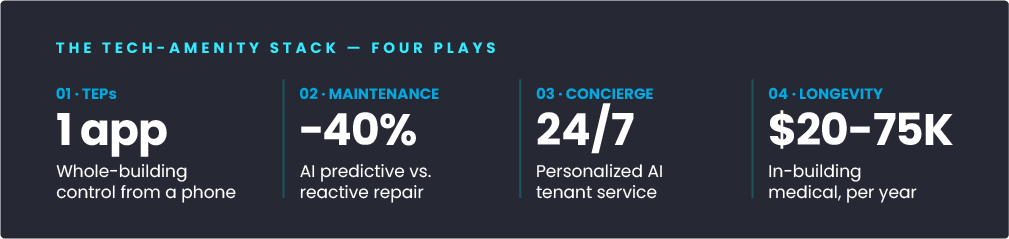
Today, nearly everything is managed from a phone app. A person’s cell phone acts a remote control for the world around them—and their apartment or office building should be no different. It is more than wanting the ease and convenience of operating building features from a phone; tenants expect it. A Tenant Experience Platform or TEP is a fully integrated software program that connects the user to the property. One management company described TEPs as the bridge between the physical space and the digital world.
TEPs can be used to control everything from building access, like entering the parking garage, the building or an individual unit, to operating building functions, like lighting and media systems, to communicating with property management. This is the core of a tech-enabled property, but it isn’t always as simple as creating an app. The property must have smart infrastructure integrated throughout that is supported through the app function. While existing buildings can create some upgrades to deliver a TEP, new developments have the opportunity to create a complete and seamless TEP system.
Predictive Maintenance and Controls
Even the best maintenance systems are merely reactive to a problem, but with AI, maintenance programs have the capability of catching maintenance issues in advance. With IoT sensors installed on major building functions, like HVAC, electrical panels and elevators, AI algorithms can accurately predict maintenance challenges before they happen. It’s like having your own crystal ball.
Residents reduce the amount of time that they have to communicate with management over maintenance issues or lose functionality of core features during repairs. The predictive system can identify maintenance needs and coordinate the repair, even working with the tenant. This is an enhancement from the digital maintenance reporting that has become popular in recent years. The AI-system aims to take the tenant out of the cycle to locate and execute repairs, giving tenants a more seamless and maintenance-free experience.
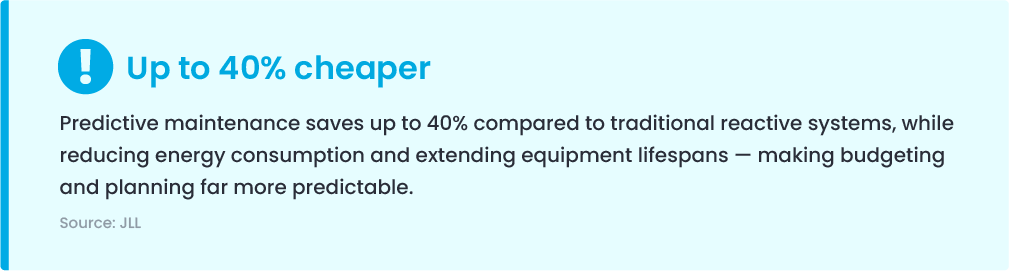
Even better, property owners save money with this model. Predictive maintenance saves up to 40% compared to traditional reactive systems, while also reducing energy consumption and extending equipment lifespans. This system also makes budgeting and planning more predictable.

AI Concierges
A few years ago, commercial properties began integrating chat bots into the leasing process and tenant services. These chatbots could answer basic questions and handle single-task assignments. Now, AI concierges are elevating the experience. AI concierges can handle more complex questions or situations, pivoting and responding to residents based on their specific and individual needs, not merely a pre-determined script.
This technology is taking over tenant services by handling everything from maintenance requests and lease renewals to elevated, luxury requirements, like allowing tenants to leverage the software as a personal assistant. The latter is powerful in that it can deliver a highly personalized tenant experience, something that more and more tenants want in today’s competitive market. The AI agent provides 24-7 communication, giving tenants universal access to management, and it is accessed through the TEP for seamless integration.
Longevity Services
Health and wellness is a critical amenity in many asset classes, from multifamily to office to hotels. Fitness centers have been the cornerstone of that experience, along with additional amenities, like saunas, fitness classes and relaxation spaces. Now, health and wellness is getting a tech upgrade with longevity services. In one of New York City’s largest mixed-use projects, longevity company Atria Health and Research Institute is providing diagnostic services like whole body MRIs, genetic screening and advanced heart imaging to building residents for the cool member price of $20,000 to $75,000 a year.
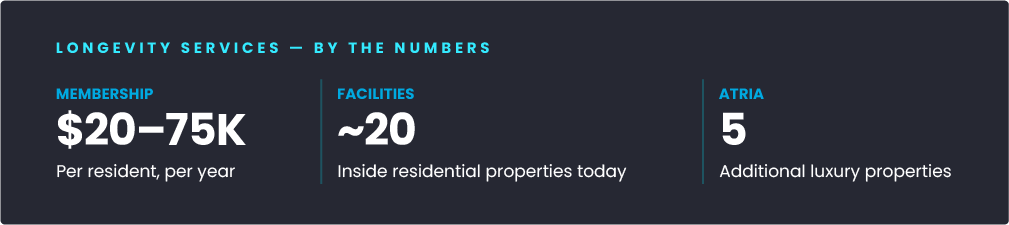
This is not an anomaly. The Wall Street Journal reports that longevity services are becoming a more common amenity in luxury buildings as a way to capture tenant interest. “Developers are increasingly chasing affluent consumers by offering them longer lives through medical technology.” Healthcare services are not new, but the technology is what makes this possible as a community amenity because it combines diagnostics and intervention services with continuous tracking models. The system works best if your customer is close. There are currently about 20 of these facilities located inside residential properties, but the model is expanding. Atria, for example, has facilities in five other luxury properties.
Technology is ubiquitous. People use it throughout their daily lives, and they expect the ease and convenience that it brings. These new amenities show that developers are thinking of creative ways to deliver an enhanced experience through technology—and it is likely just the beginning of a new suite of tech amenities in commercial real estate projects.