
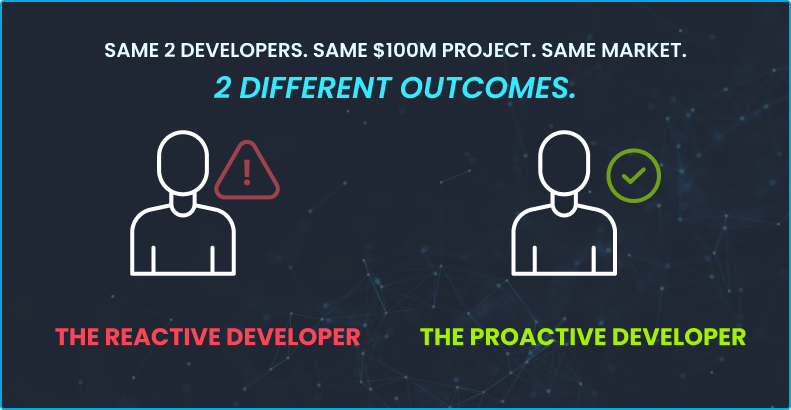
The New Reality: Every Real Estate Project is a Battle
In 2025’s commercial real estate landscape, volatility has become the rule, not the exception. Interest rates have seesawed to heights not seen in decades, material costs remain unpredictable, and tariffs or supply chain kinks can send project budgets reeling.
The result? Developers are facing an epidemic of budget overruns and schedule delays.
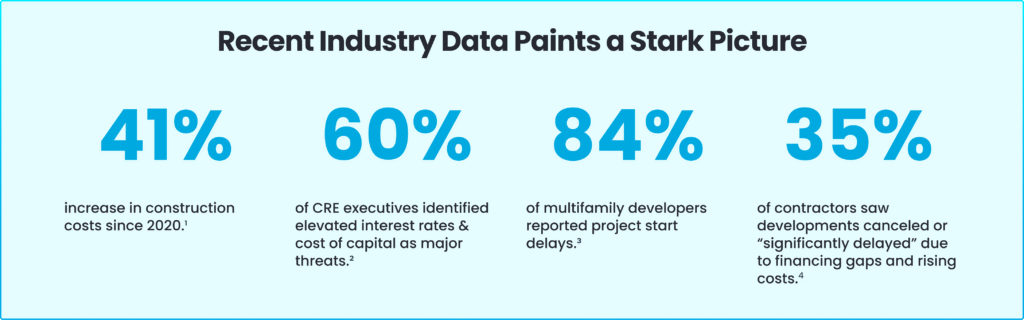
In short, CRE developers are operating in a perfect storm of tighter capital, pricier materials, and economic uncertainty.
Proactive cost and schedule management is now mission-critical. The old playbook of “baseline a budget and hope for the best” is failing against today’s headwinds. To survive and thrive, developers must confront a hard truth: reactive project management and critical financial data in spreadsheets simply don’t cut it in a volatile market
The High Cost of Reactive Project Management
Too many development teams today realize there’s a problem only when it’s too late to fix. Reactive project management – waiting until a budget is blown or a deadline slips to course-correct – carries a heavy price.
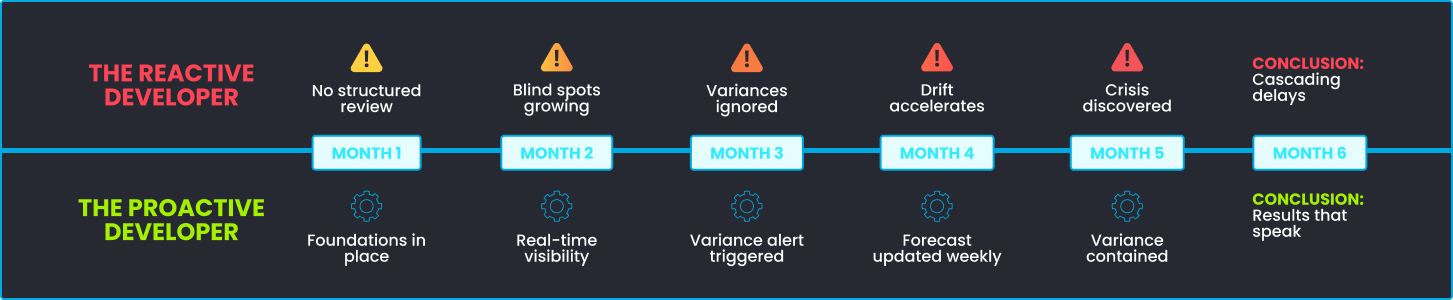
These failures aren’t due to laziness or lack of expertise; they’re often caused by workflows that fail to identify issues until after the damage is done. For example, if a project manager only reviews cost performance once a month, a rapidly escalating expense can run unchecked for weeks. By the time the overrun surfaces in a report, the team is already in a deep hole – forced into expensive scrambling to rebalance the budget or cut scope.
Schedule slippage works the same way: a small delay in one phase, unnoticed and unmitigated, cascades into a big delay by project’s end. Reactive management turns developers into perpetual firefighters, chasing one urgent issue after another. Not only does this erode project financials, it also undermines team morale and stakeholder confidence. When every update seems to bring bad news, investors and lenders grow anxious. In contrast, a proactive stance aims to catch risks early before they erupt into full-blown overruns, thereby avoiding the domino effect of crisis management.
First, let’s dig deeper into why these overruns and delays keep catching teams off-guard.
Volatile Market Impacts: Real-World Delays and Overruns
What does all this look like in practice? Unfortunately, recent data reads like a list of a developer’s worst nightmares.
Project delays have become widespread, often linked to financing and cost volatility. In late 2024, an incredible 84% of multifamily developers reported delays in starting new projects, largely due to economic uncertainty.6
By mid-2025 that figure improved but was still a daunting 70%.7
These aren’t minor hiccups – they represent entire project pipelines pushed back, waiting for costs to stabilize or loans to pencil out. Even projects already underway are feeling the strain. A National survey of contractors in 2025 found that 70% faced delayed payments, leading many to inflate their bids by ~8% to cushion against risk. Furthermore, ConstructConnect data showed a 40% increase in private projects placed on hold year-over-year.8
In plain terms, a lot of developments have hit the brakes. Why? Because when materials suddenly cost 20% more than budgeted or interest expenses jump unexpectedly, developers are forced into tough choices: pause, reprice, or cancel.
Delays often march hand-in-hand with cost overruns. Permitting delays, for instance, have worsened in many regions – 85% of developers surveyed in June 2025 experienced permitting disruptions, up from 77% a year earlier.9
Every month waiting on permits is a month of extra financing costs and idle crews, which can blow through contingency funds fast. And don’t forget tariffs and trade policy: the fluctuating tariffs on imports have made future construction costs “less predictable,” introducing yet another wildcard.10
The compounding effect of these factors is evident in bottom-line expectations. In one sector, 72% of developers reported having to reprice deals in Q2 2025 due to market conditions – essentially adjusting financial models to account for higher costs or slower timelines.11 Many now expect continued cost increases into next year.
For developers, these stats confirm that volatile market forces are translating directly into project overruns and delays. What used to be rare worst-case scenarios are happening with alarming regularity.
In the next section, we’ll examine how these overruns and delays impact developers’ profitability, and why simply “hoping things work out” is not an option if you want to thrive in this volatile climate.

Margin Compression: The Financial Squeeze of Poor Control
Every late month and every extra dollar hits profit, directly. With thin margins, a 10 – 15% overrun can wipe out a 10% underwrite.12 Once you add financing, carry and delay costs, the damage compounds. Six months late often means hundreds of thousands in extra interest, extended general conditions, and lost rent. If you expected $5M in profit and overruns consume $5M, the return is zero.
A report from C&S Insurance in mid-2024 put it plainly: “Projects planned on pre-inflation budgets are facing cost overruns, impacting profitability and financial viability.”13
When margins shrink or turn negative, the damage is not only on paper. Cost overruns correlate with delayed delivery, covenant stress, and heavier financial strain.
Schedule delays contribute to margin compression as well. Time is money in development – every extra day means higher interest payments, extended general conditions costs, and delayed revenue from sales or leases. If a building is delivered 6 months late, that could mean hundreds of thousands in additional financing costs and lost rent. These are “hidden” overruns that many pro formas don’t fully capture upfront.
It’s also worth noting the opportunity cost: capital and resources tied up in an overextended project can’t be deployed elsewhere. In a sense, firms missing their targets may lose out twice – once on the troubled project and again on the next opportunity they had to forgo.
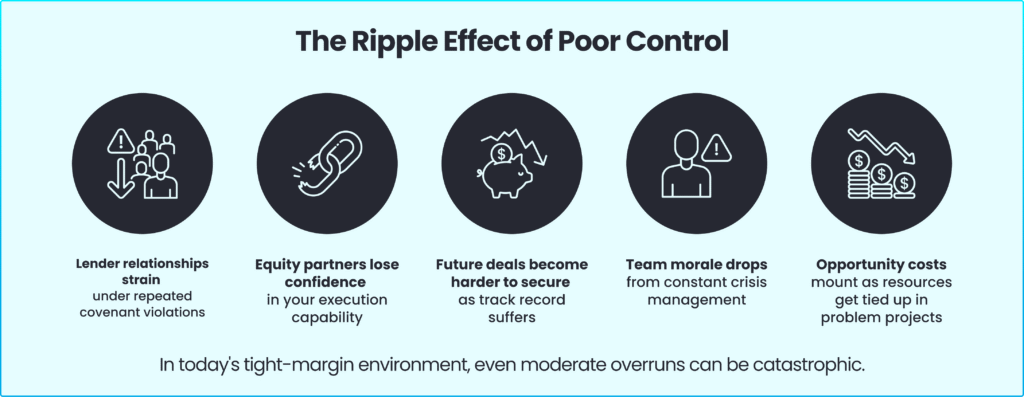
All of this underscores a critical point: the margin for error is gone. In a volatile market, developers must either find ways to maintain tighter control over costs and schedule or face serious financial consequences. The good news is that the industry is waking up to this reality and seeking solutions.
Modern Development Operations: From Reactive to Proactive
Cutting-edge development teams are replacing rear-view reporting with live control. The shift starts with a single source of truth that ties budgets, commitments, change orders, and schedules into one system. When data lives in one place, variances surface instantly and the forecast updates in real time. A $200,000 overage no longer hides in a workbook. It appears in the EAC, triggers an alert, and prompts action while the variance is still small.
Forward-looking metrics make this discipline tangible. Teams monitor Estimate at Completion and expected finish date continuously, then pressure-test the plan with scenario models. What happens if lumber rises 10 percent or permitting stretches 90 days? With integrated data, those “what ifs” turn into clear cost and timeline impacts that inform preemptive moves rather than last-minute cuts.
Predictive analytics is raising the bar further. Adoption is accelerating across real estate, with industry surveys and outlooks highlighting AI’s growing role in planning and risk detection. Many teams now mine historical project data to flag vendors, contract structures, or trades that tend to drive change orders, then act before those patterns repeat.
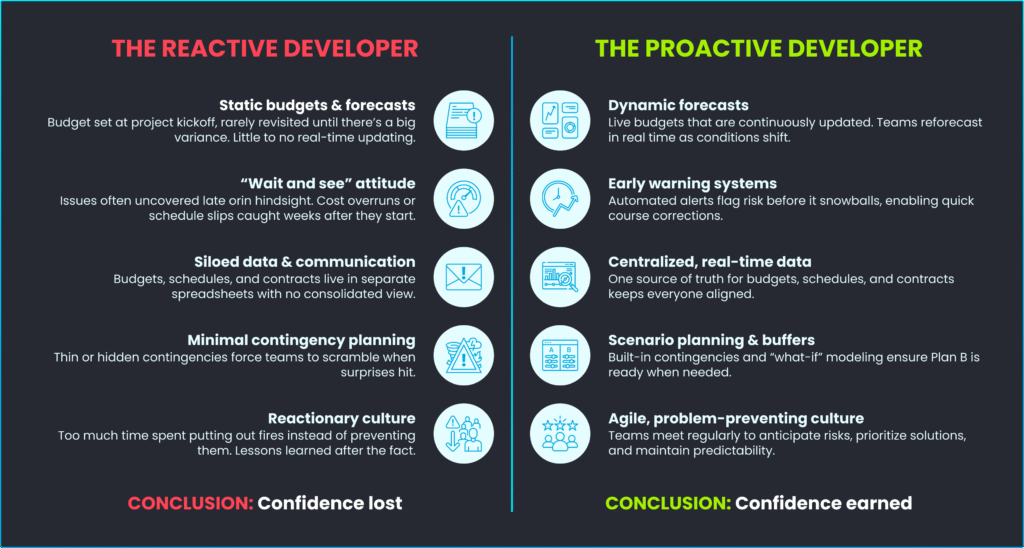
This operating model also changes how partners work. Cloud platforms let owners, architects, contractors, and lenders review the same budgets, schedules, and documents. Select dashboards shared with equity or lenders build trust and speed decisions because everyone sees the same indicators at the same time.
To quantify the benefits: The Boston Consulting Group estimated that full digitalization in construction could reduce project costs by up to 20% and shorten timelines by as much as 30%.16 Those are huge numbers that could spell the difference between a project that barely breaks even and one that beats its pro forma.
The Solution Northspyre: Real-Time Cost and Schedule Management at Scale
Northspyre is a purpose-built development management platform that centralizes cost, schedule, and vendor workflows into one intelligent platform. Designed to eliminate manual processes and reactive decision-making, Northspyre helps teams forecast risk, prevent overruns, and drive more predictable outcomes.
Budget Visibility and Control
Northspyre gives your team a single source of truth for project budgets, combining commitments, change orders, and actuals into one continuously updated dashboard. Users can instantly see what has been spent, what is pending, and where exposures are trending. If a budget line item begins to exceed forecast, Northspyre flags it immediately so your team can act before it escalates.
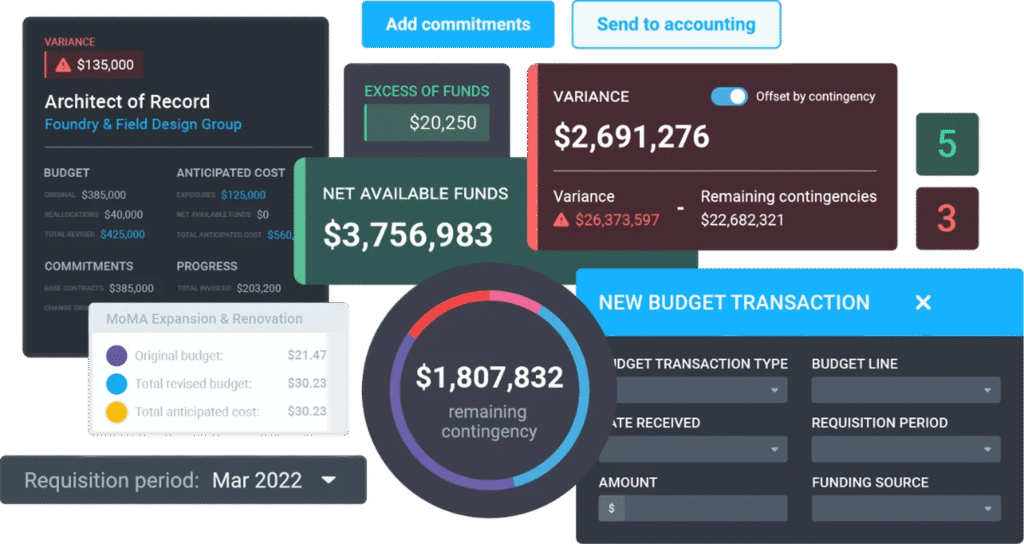
“Northspyre allows us to, in real time, click a button and see all invoices, understand why we created exposures, and get all that detail on a line-by-line basis.”
— GMH Communities
Forecasting and Risk Mitigation
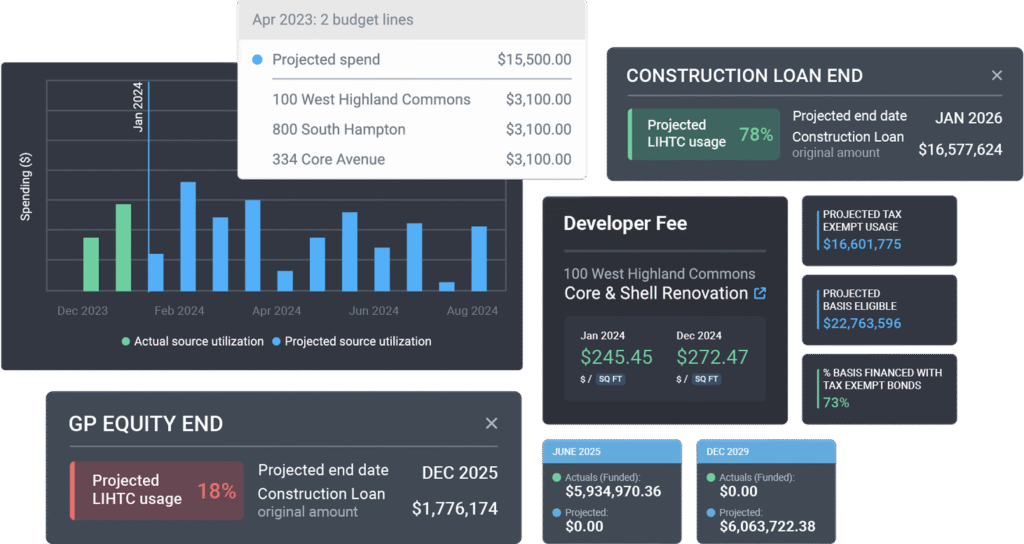
Northspyre projects final costs based on current trends, allowing teams to take proactive action months before completion. The platform ties schedule slippage to cost impacts and provides early warnings tied to scope changes or trade risk, helping mitigate budget blowouts.
Seamless Financial Integration
Northspyre integrates directly with accounting systems like Sage, MRI, and QuickBooks. This eliminates duplicate data entry and ensures that development and accounting teams are aligned on real-time financials. One project manager shared that they used to manually copy financial codes from one system to another—Northspyre makes that unnecessary.

“With Northspyre, it allows us to have one consolidated system, so we all know that what we’re looking at is the most current and the most accurate.”
— Newell Development
Automation That Scales with You
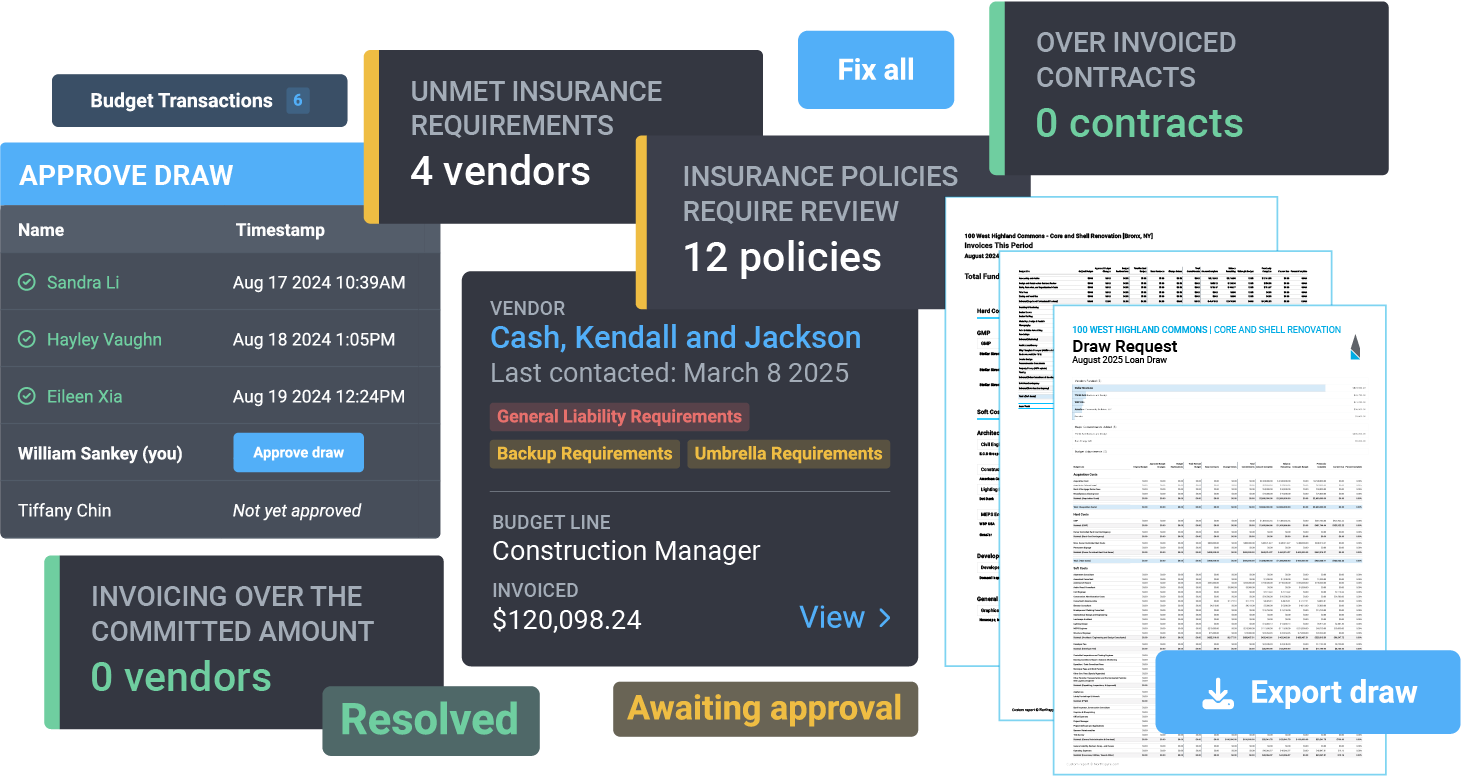
Routine tasks like invoice logging, draw requests, vendor approvals, and report generation are automated within Northspyre. This reduces the time spent on administrative work and frees up bandwidth for strategic activities such as vendor negotiations or pipeline expansion. Teams report saving 30 to 40 percent of their week on previously manual tasks.
In short, Northspyre enables development leaders to eliminate budget surprises, reduce financial risk, and manage more projects with fewer resources.
Benefits of Proactive Control: Predictability, Efficiency, and Profit
Northspyre’s proactive, data-driven approach delivers tangible ROI.
By replacing reactive reporting with real-time visibility and intelligent automation, developers unlock five key benefits:
Minimize Budget Overruns
Continuous monitoring and predictive forecasting help teams identify cost risks early before they spiral. Northspyre flags issues like scope gaps and overages, enabling timely interventions such as vendor renegotiation or design changes.
Accelerate On-Time Delivery
When delays are surfaced in real time, teams can act fast by reallocating resources or resequencing work to stay on schedule. Meeting key milestones means faster revenue realization and lower carry costs. In some cases, Northspyre users even complete projects ahead of schedule.
Scale Without Additional Overhead
Automated workflows reduce admin load by 30–40%, freeing teams to focus on high-impact work. Developers can manage more projects with the same staff, increasing portfolio velocity and improving margins.
Build Investor Confidence
Real-time dashboards and proactive reporting foster transparency with capital partners. When investors see tight financial control and no surprise overruns, trust grows—opening doors to better terms and faster funding cycles.
Move Faster in the Market
With up-to-date cost, schedule, and vendor data, developers can seize opportunities quickly—whether that’s refinancing, adjusting timelines, or taking on new deals. Market agility starts with internal clarity.
See Northspyre in action
See how leading developers use Northspyre to work smarter at every stage of the development lifecycle.
Sources
- “2026 Commercial Real Estate Outlook.” Deloitte Insights, Deloitte, 7 Oct. 2025, www.deloitte.com/us/en/insights/industry/financial-services/financial-services-industry-outlooks/commercial-real-estate-outlook.html.
- Wishingrad, Emily. “Delays, Cancellations of Construction Projects Becoming More Common.” Bisnow, 21 May 2025, www.bisnow.com/national/news/construction-development/1-in-3-construction-projects-delayed-or-canceled-129469.
- Sherman, Erik. “Developers Grapple with Delays and Repricing in Multifamily Market.” Benefitspro.Com, Globe Street, 27 June 2025, www.globest.com/2025/06/27/developers-grapple-with-delays-and-repricing-in-multifamily-market/.
- Wishingrad, Emily. “Delays, Cancellations of Construction Projects Becoming More Common.” Bisnow, 21 May 2025, www.bisnow.com/national/news/construction-development/1-in-3-construction-projects-delayed-or-canceled-129469.
- Brenner, Joel. “Directing Multiple Project Teams toward One Shared Goal.” Market Share, 30 Oct. 2024, blog.naiop.org/2024/10/directing-multiple-project-teams-toward-one-shared-goal/.
- Sherman, Erik. “Developers Grapple with Delays and Repricing in Multifamily Market.” Benefitspro.Com, Globe Street, 27 June 2025, www.globest.com/2025/06/27/developers-grapple-with-delays-and-repricing-in-multifamily-market/.
- Sherman, Erik. “Developers Grapple with Delays and Repricing in Multifamily Market.” Benefitspro.Com, Globe Street, 27 June 2025, www.globest.com/2025/06/27/developers-grapple-with-delays-and-repricing-in-multifamily-market/.
- Wishingrad, Emily. “Delays, Cancellations of Construction Projects Becoming More Common.” Bisnow, 21 May 2025, www.bisnow.com/national/news/construction-development/1-in-3-construction-projects-delayed-or-canceled-129469.
- Sherman, Erik. “Developers Grapple with Delays and Repricing in Multifamily Market.” Benefitspro.Com, Globe Street, 27 June 2025, www.globest.com/2025/06/27/developers-grapple-with-delays-and-repricing-in-multifamily-market/.
- Wishingrad, Emily. “Delays, Cancellations of Construction Projects Becoming More Common.” Bisnow, 21 May 2025, www.bisnow.com/national/news/construction-development/1-in-3-construction-projects-delayed-or-canceled-129469.
- Sherman, Erik. “Developers Grapple with Delays and Repricing in Multifamily Market.” Benefitspro.Com, Globe Street, 27 June 2025, www.globest.com/2025/06/27/developers-grapple-with-delays-and-repricing-in-multifamily-market/.
- Staff, LAI. “The Price of Getting It Wrong in Real Estate Development – Lai Design Group.” LAI Design Group – Designers Who Think like Developers, 26 Mar. 2025, www.laidesigngroup.com/the-price-of-getting-it-wrong-in-real-estate-development.
- “The Impact of Construction Inflation Rates in 2024.” C&S Insurance, 19 Aug. 2025, www.candsins.com/blog/the-impact-of-construction-inflation-rates-in-2024/.
- tbd
- tbd
- Uphus, Rich. “Constructing Success in 2024.” FullClarity, 4 Sept. 2024, fullclarity.com/2024/06/10/constructing-success-in-2024-fullclarity-automation-success/.